This weekend I was going through a box of things I inherited when my dad passed away. A lot of it came to him from his father, Frank Edward Wade. My dad called him Pop, and from what I understand, so did a lot of other people.
I never really knew Pop. He died in July 1976, a month short of my second birthday. Everything I know about him is secondhand, and it all says the same thing. He was a great guy.
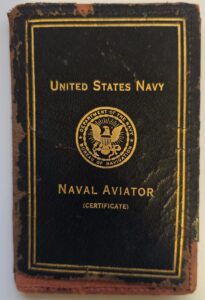
In that box was a small leather folder, about the size of a passport. Gold lettering on the front: United States Navy, Naval Aviator (Certificate). Tucked inside it was a beat-up little membership card for something called the Quiet Birdmen.
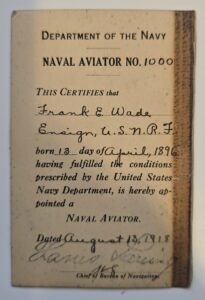
Naval Aviator No. 1000
The folder opens like a passport. On the left is the certificate itself, from the Department of the Navy. It says that Frank E. Wade, Ensign, U.S.N.R.F. (the Naval Reserve Force), born 13 April 1896, has met the conditions set by the Navy Department and is appointed a Naval Aviator. It’s dated 13 August 1918 and signed for the Chief of the Bureau of Navigation, who at the time was Rear Admiral Leigh C. Palmer.
And right at the top, filled in by hand: Naval Aviator No. 1000.
Not 986. Not 1,247. One thousand. That’s the number I’d pick if I were making it up, and I’m not.
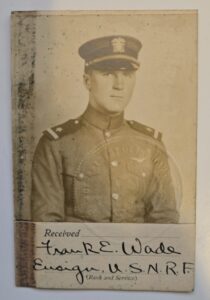
On the right is his photo. He’s 22, in his ensign’s uniform, with his Navy wings already pinned to his chest. The Navy’s seal is pressed right into the picture. Under it he signed his name and rank.
I’ve looked at a lot of old records doing genealogy. This is the first one that felt like it was handed to him, not filed about him.
The Quiet Birdmen
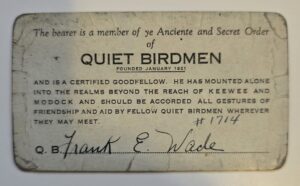
The card is worn, cracked, and soft at the corners, like it lived in a wallet for a long time. It says the bearer is a member of “ye Anciente and Secret Order of Quiet Birdmen,” founded January 1921, and a certified goodfellow. My favorite line says he has “mounted alone into the realms beyond the reach of Keewee and Modock,” and that fellow Quiet Birdmen should give him friendship and aid wherever they meet. It’s signed Q.B. Frank E. Wade, number 1714.
I had never heard of them, so I looked them up. Here’s the short version:
- It’s a secretive club for aviators, started in New York in 1921 by World War I pilots. You join by invitation only, and you’re a member for life.
- The name is a joke. A magazine editor called them the Quiet Birdmen because they were anything but. They eventually got kicked out of the restaurant they met in, possibly for being too loud.
- Lindbergh, Eddie Rickenbacker, Jimmy Doolittle and Wiley Post were all members.
- They even invited Ernst Udet, the top German ace to survive the war. The guy they’d been shooting at.
- Before 1938 they had a rule against having a constitution, by-laws, dues or officers. Which tells you most of what you need to know.
- The club is still around, organized into local “hangars,” with its headquarters at Flabob Airport in Riverside, California.
So Pop wasn’t just a Navy pilot. He was one of the boys.
What I don’t know yet
A find like this answers some questions and opens a few more. I’m writing them down, because I’ve learned that’s the only way they get chased.
When did he join up? My family history site, webbwade.com, says he joined the Naval Reserve Flying Corps in April 1917 at 22, and was commissioned that August, probably the day he got his wings. The certificate doesn’t agree. His wings are dated August 1918, and with an April 1896 birthday he’d have been 21 in April 1917. If he actually joined in April 1918, everything lines up. So that’s my own site getting it wrong, or at least not right yet. I need to find his enlistment record.
When did he become a Quiet Birdman? The card has his number, 1714, but no date. The Goodfellow Historical Foundation collects and catalogs the club’s history, so they may be able to tell me.
Is he in the yearbook? In May 1936 the club printed a leather-bound membership book with 640 member photos. One copy was donated to Wright State University in Dayton in 2007. I’m going to ask them to check.
Did he sign in? The New York hangar kept leather-bound sign-in books for its meetings. A couple of them are out there with a bookseller. Pop’s signature could be in one.
His wings
Pop served again in the Second World War, as a lieutenant. He lived to 80. I was here for less than two years of that, and I don’t remember any of it.
But I have his wings now. I have the certificate he carried, the picture of him at 22, and the card that says he’d gone up alone and come back a goodfellow. That box sat with my dad for decades before it came to me. I’m glad I finally opened it.
Pop’s page is on webbwade.com at https://webbwade.com/people/9N2F-N1M-frank-edward-wade along with the rest of the Wades. If any of the open questions above get answered, that’s where it’ll show up first.
Say something