Two things I love
I love music. These days that means a lot of Steely Dan, a lot of prog rock, and a growing stack of vocal jazz on vinyl. I also love data. I spend my working days in metrics and dashboards, and I’m always the guy who wants to know why the line went up.
For years those two lived in separate rooms. Spotify gave me a Wrapped every December. I’d look at it for five minutes and that was that. I couldn’t ask it anything. I couldn’t slice it by month or by hour of the day, and I definitely couldn’t ask what I was listening to on this day five years ago.
Listening Post is where the two finally overlap. It’s a personal app that keeps every song I play, fills in everything it can find about it, charts it every way I could think of, and lets Claude talk to me about all of it. Honestly, it was the obvious project. I’m a little surprised it took me this long.
Spotify forgets
It started with a simple wish. I wanted Claude to see my liked songs, what I’d been listening to lately, and what I was listening to six months or a year ago. Then I wanted it to look at all of that and recommend things. I also wanted a place for the albums Claude recommends to land, because I was tired of digging back through old chats to find “that Renaissance record you mentioned.”
My first question was whether somebody had already built this. There are a few Spotify MCP servers out there, and they handle playback and playlists just fine. None of them have history, and there’s a good reason for that. Spotify’s “recently played” only gives you your last 50 tracks. That’s about three hours of music. The top artists and tracks endpoint goes back about a year, but it’s a ranked list. No dates, no play counts.
I swore I’d built something years ago that pulled more history than that. Talking it through, I’m pretty sure I just kept paging backwards and it never actually gave me more. It just felt like it did.
So the answer was to own the data myself. Ask Spotify for my recent plays every few minutes and save them before they fall off the end. Then do a one-time import of my extended streaming history, which Spotify will send you as a pile of JSON files if you ask from your privacy settings. Spotify also shut off its own recommendations to new apps, which turned out not to matter. Claude does the recommending.
Planning it out loud
I planned the whole thing with Claude in a voice conversation on October 23rd. I talked, Claude asked questions and pushed back, and a spec document grew in real time while we went. By the end of the night it was about 700 lines.
A handful of decisions shaped everything else. It’s just for me. One user, Google sign-in, no friends list. It’s Laravel, like my Discogs connector and Tally Up, and it runs on the same server. Spotify sits behind a swappable provider, so if I ever leave Spotify I keep my history and everything built on it. The To Listen list lives on my server, not in a Spotify playlist, and it holds albums, tracks, or whole artists. And because a good portion of my listening happens in my vinyl room now, I can log a record by voice and it counts like anything else.
Then there was the part I was most excited about. My exact words were, “We’re going to have all of this crazy data, and I’m really going to want some interesting graphing.” I asked for a dashboard where I could chart anything I wanted, pin my own widgets, and change one time filter at the top that updates every widget on the page. I also asked Claude to really think about which default widgets would actually tell me something.
We cut things too. No concert alerts. Claude pitched a “what do I listen to on rainy days” widget. Tempting, but no. No skip tracking either, because I skip songs I love just because I’m not in the mood, and that would make the data lie. The recommendation log records itself, because I didn’t want to feel like I had to respond to every suggestion.
The last thing we settled was how Claude Code would work on it. A branch for each phase, small commits, and no pull requests or CI since it’s just me. When a phase is done and the tests pass, Claude stops and tells me. Nothing gets merged or pushed to GitHub until I say go. And it never touches the production server without asking.
Building it
The spec went into the repo as docs/spec.md, and from then on that copy was the source of truth. I handed it to Claude Code and worked through it phase by phase. The first commit landed at 9 PM on October 23rd. By lunchtime the next day, all three phases were merged: the foundation and data collection, the enrichment and dashboard, and the extras like milestones and the landing page.
That was the easy part. The month after was real life.
Spotify was the biggest fight. Apps like mine run in what Spotify calls development mode, and the quota is shared across your whole developer account. During the import backfill I kept hitting a limit that locked me out for most of a day at a time. I got frustrated enough that I seriously looked at leaving Spotify. Claude researched the alternatives with me, and none of them can start music on my phone in the car the way Spotify can. So I stayed and put Spotify on a diet instead. Listening Post now asks MusicBrainz first, and only goes to Spotify for what MusicBrainz can’t settle, with an hourly cap and a daily budget.
There were smaller surprises too. Every time I got in and out of the car, Spotify logged the song I’d paused as a brand-new play, so some songs looked a lot more popular than they were. Now a song paused and picked up again counts once.
The vinyl logging got a lot of polish. I’ll say something like “we listened to Chet Baker Sings last night around 9,” and Claude checks my Discogs collection for the pressing I actually own. Then it logs only the tracks on my LP, not the bonus takes on the streaming version. (If you read Identifying a Record from the Dead Wax, that’s the same Discogs connector.)
As of today the repo is sitting at 207 commits, with 39 tools Claude can call.
The dashboard
This is the page I open the most. Here it’s set to the last 90 days, and everything on it compares itself to the 90 days before that.
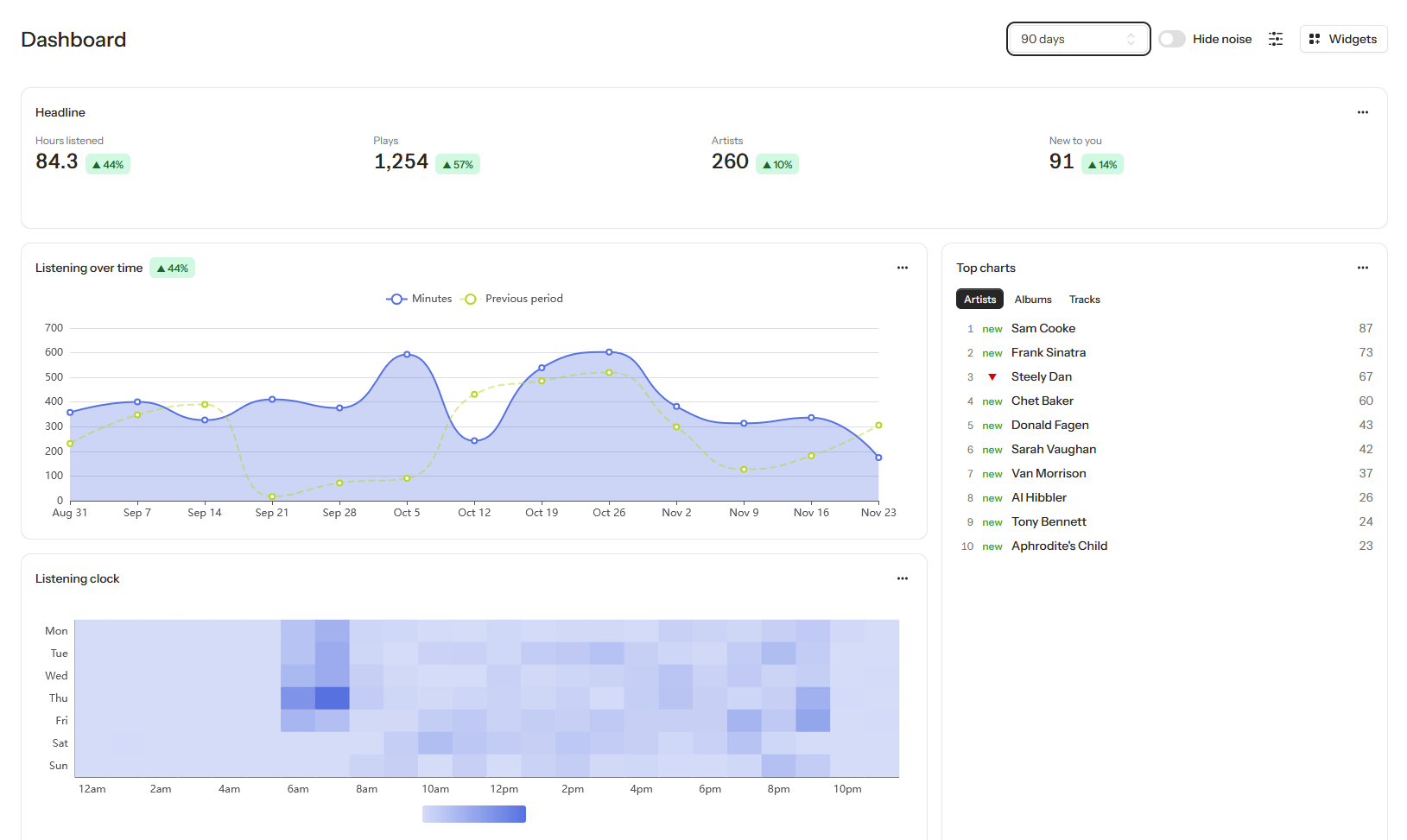
The headline strip is the quick version. 84.3 hours, 1,254 plays, 260 artists, and 91 of them new to me. All of it up from the previous 90 days, plays by 57%.
The top charts are where it gets fun, because they tell a story I didn’t have to write down. Sam Cooke is at number one with 87 plays, and he’s marked “new.” So are Frank Sinatra, Chet Baker, Sarah Vaughan, Al Hibbler, and Tony Bennett. Steely Dan, who owned the top spot most of the year, has slipped to number three. That’s the vocal jazz kick showing up in the data, plain as day.
The listening clock is a heatmap of hour of day against day of week. The darkest square is Thursday between 6 and 8 in the morning. I’m not entirely sure what that says about my Thursdays.
That’s just what fits on the screen. Further down are widgets for plays by release decade, how my genres drift over time, how much of my listening is new versus familiar, forgotten favorites I haven’t played in a while, my To Listen progress, recent sessions, on this day, and new albums from my favorite artists. The “Hide noise” toggle at the top filters out artists and genres I only played once or twice, so the charts aren’t buried in one-offs. And if I want something that isn’t there, I can build my own widget, or just ask Claude to pin one for me.
Year in Review
This is my own Wrapped, except I don’t have to wait until December, and I can pull up any year I want. Thanks to the streaming history import, the tabs go all the way back to 2016.
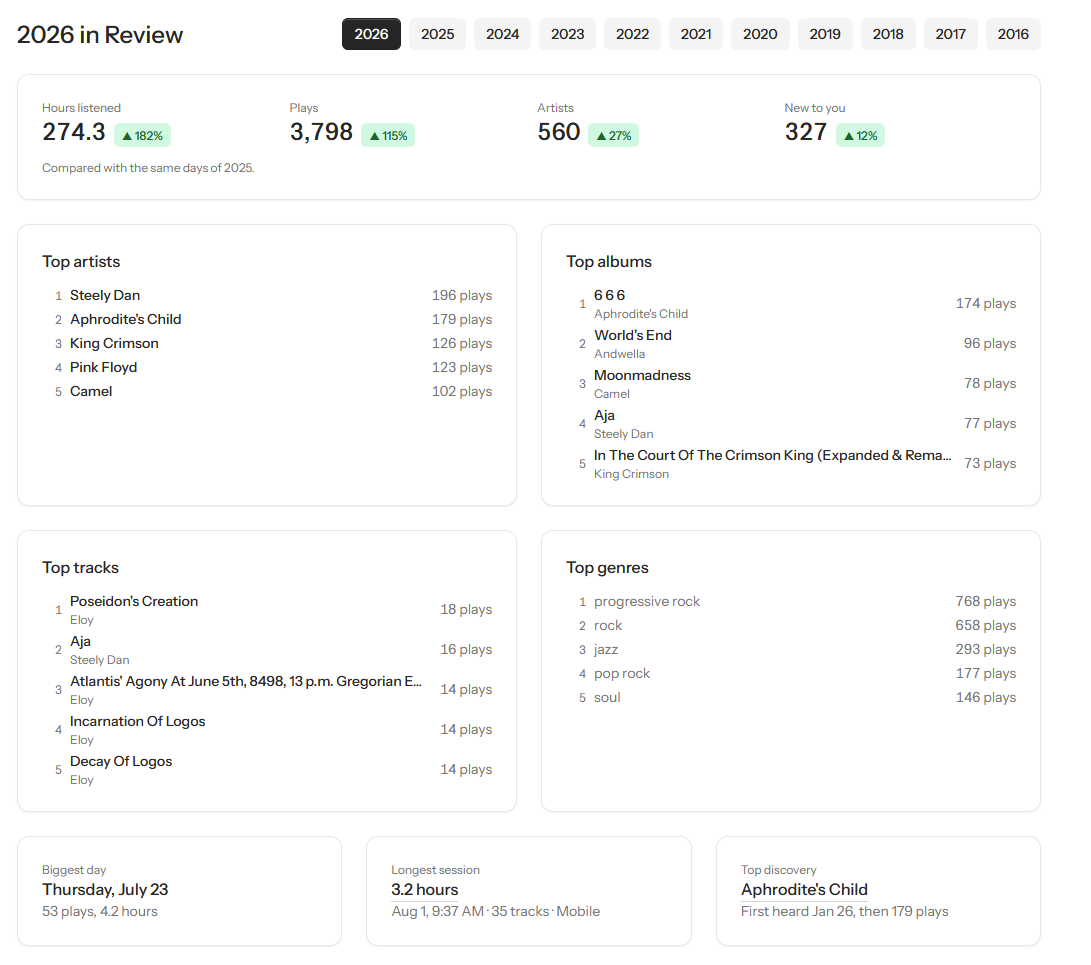
So far in 2026 I’m at 274.3 hours and 3,798 plays, up 182% from the same days last year. Steely Dan is my top artist with 196 plays, which surprises no one who knows me. Right behind at 179 is Aphrodite’s Child, a band I’d never heard until January 26th. That’s why they’re also my top discovery. Their album 666 has 174 plays all by itself.
The top tracks are a little embarrassing. Four of the five are Eloy, a German prog band, and the fifth is “Aja.” Apparently I went through an Eloy phase this year and didn’t fully realize how deep I was in it.
The cards at the bottom are my favorite part. My biggest day was Thursday, July 23rd, with 53 plays and 4.2 hours. My longest single session was 3.2 hours on August 1st. Below the fold are minutes by month and a listening clock for the whole year.
Milestones
This is the page that makes me laugh. Every night Listening Post goes back over my whole history looking for badges. Some are the standard stuff you’d expect. I passed 10,000 total plays on September 18th, I’ve heard more than 1,000 different artists, and I’ve hit 100 plays of a single artist 19 different times.
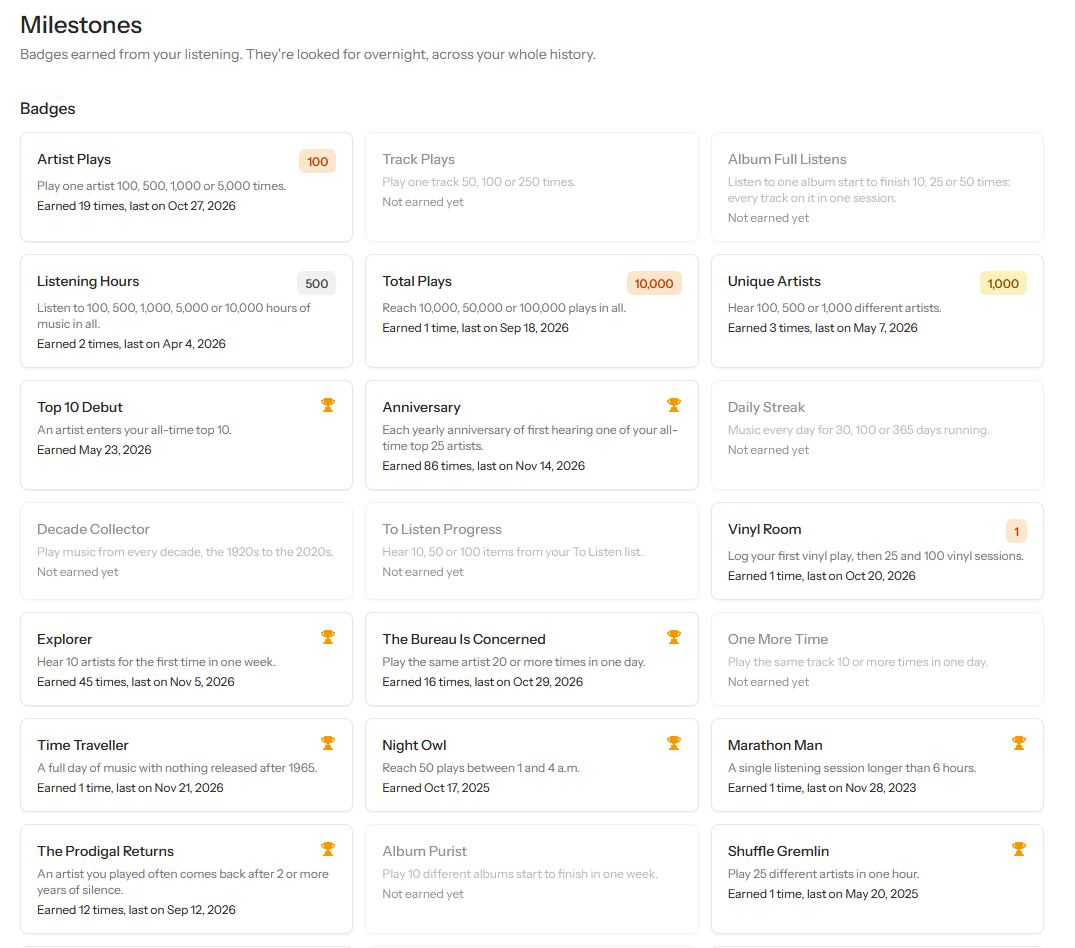
The funny ones are the reason the page exists. “The Bureau Is Concerned” is for playing the same artist 20 or more times in one day, and I’ve earned it 16 times. “Time Traveller” is a full day with nothing released after 1965. I got that one a week ago, which tracks with all the Sinatra and Chet Baker. “Marathon Man” is a single session over six hours, and that one dates back to November 2023. The import found it, and I have no memory of that day at all.
The grayed-out ones are what I haven’t earned yet, like a 30-day listening streak or playing ten albums start to finish in one week. Further down are more I’m still chasing, like “Ghost Liker” for a liked song I haven’t played in two years, and “Commitment Issues” for liking a song and then unliking it within a month. Each badge has its own page listing every time I earned it and why. New ones show up in my morning briefing too, so I hear about them in the car.
The Bureau of Auditory Surveillance
An app for one person doesn’t need much of a public page. It just needs somewhere to land and log in. I asked Claude for something funny that would make people wonder what in the world they’d stumbled onto, and it came back with the Bureau of Auditory Surveillance.
If you go to listeningpost.codewalkers.net, you get a deadpan government agency. Its motto is Audimus Omnia, “We Hear Everything.” The status line reads “Subjects monitored: 1.” There’s a daily Auditory Threat Level that runs from Elevator up through Brushes on Snare and Bebop, all the way to Free Jazz, where the orders are “Shelter in place.” A ticker runs fake intercepts like “Subject hummed along. Off key. Logged.” The login button says “Authorised Ears Only.”
I liked it so much I asked for a lot more of it. There are Field Reports, Public Advisories, a Most Wanted page for The Shuffle Bandit and The Intro Skipper, a Careers page hiring a Vinyl Crackle Interpreter, and a Report a Suspicious Listener form that just says “Thank you. We already knew.” Each page is written so search engines will pick it up, because the idea of a stranger landing there from Google makes me happy. None of it uses my real listening data. It’s all made up.
The footer on every page says “A Codewalkers production. The Bureau regrets nothing.”
Where this leaves me
The charts are great, but the part I use the most has no screen at all. In the car I can ask Claude what I’ve been into lately, what I was listening to on this day a few years ago, or to play the next thing on my To Listen list. When Claude recommends a record now, it goes straight onto that list and doesn’t get lost in a chat. When we listen to a record in the vinyl room, it gets logged.
The data was always there. Spotify had it and just wasn’t telling me. Now it lives on my own server, and I can ask it anything I want.
The Bureau is concerned. I’m fine with that.
Say something